
Yesteryear does a full circle and ends back where it started: Tiktok.
My mashup of review, opinion and feminist analysis on the buzzy bestseller, which falls into the very trap it purports to criticise.

As this is my first time writing anything on Substack, I should preface it by saying that Yesteryear, the new novel by Caro Claire Burke, isn’t the kind of book I would have picked up on my own, which I mention because I was aware I had to be careful with my own biases. Still, last week I dug into it as part of Tarra's incredible bookclub, which asks for close reading and critical analysis. We’re reading it alongside Silvia Federici’s Caliban and The Witch1 — you’d have to be crazy to miss that — not to mention the fact that Tarra’s own writing and perspective are phenomenal.
The reason I normally steer clear of new bestsellers matters here too, and it isn’t because I believe something hyped on (or born out of) Tiktok necessarily means it’s not worth my time: it’s simply a matter of having an endless TBR pile that I’m certain is full of wonder which I’m eagerly waiting to get my hands on, making the task of finding the goodness among the nothingburgers of Tiktok something that can wait. Get in line. That said, once I pick up a book, it's important to me as a reader to make a conscious effort to be fully available to it, TBR be damned, which is what I tried to do here. And as I scribbled furiously, I decided I'd share some of my thoughts on this very blank space that is my Substack.
“The days of yesteryear were not for the faint of heart,” my mother would drone on, a distant, romantic look in her eye” (Yesteryear)
I'll start with the spoiler: it does fall squarely into what I think of as the “Tiktok category”. Not exactly a surprise, considering that Burke was inspired by “tradwife”2 Tiktok content to write the novel, but disappointing nonetheless as it has an interesting and very intriguing premise which, fully explored, could lead to a great story with a powerful message. Instead, Yesteryear tackles so many themes at once that it doesn’t seem to get anywhere. It kept me engaged and curious, granted, but it royally fails at genuinely engaging in political criticism — even though the subject matter demands that it does just that.
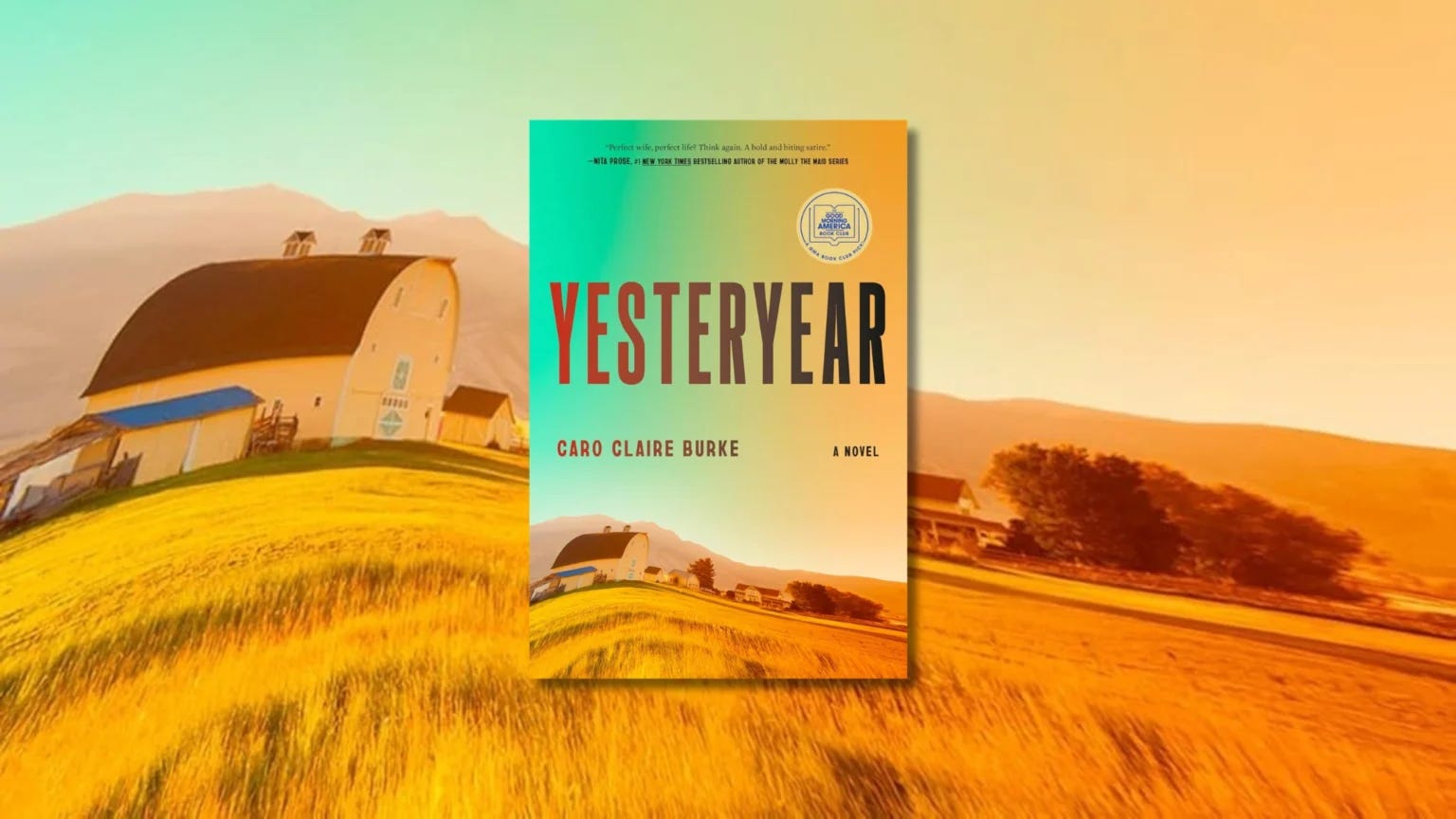
The premise: Christian (any Christian, apparently it doesn't matter), sheltered young woman leaves home to go to Harvard, is disappointed by what she finds there — “I’d come to college intent on being a shining light for others. Now I was certain that no level of illumination would save these women from the horror of themselves. If anything, they seemed to revel in the pitch-black aimlessness of their lives. They were proud of it.” — gets married to a rich, unambitious man, drops out, becomes a “tradwife” influencer, and eventually somehow finds herself back in 1855, the olden days her mother used to tell her about — which she sells on Instagram as lifestyle — only to find out it’s not all it’s cracked up to be.
Caro Claire Burke: “There are two decisions I made. Number one is that she doesn’t have a specific type of Christianity. (...) She doesn’t understand scripture. Her relationship is very transactional.” (NYTimes)
Natalie is right from the outset a character that is very easy to hate: she’s judgmental, entitled, superior, fake, cruel— to her sister, to her roommate, to her children, to her nannies, to the farm workers, to her neighbour, to her husband, to her followers — and seemingly has no redeeming qualities. She’s trapped in a caricature of the author’s making every bit as much as she’s trapped in a world she creates for herself. When we get the rare moments where there’s a glimpse of her humanity, they are powerful, complex, occasionally poignant, certainly worthy of exploration, but over before they ever get a chance to get there — shorter even than the cheering for the main character I desperately held on to but in the end couldn't sustain, either.
The first of those promising moments was for me when Natalie has her first child. She suffers from what is clearly post-partum depression, a massive issue that in 2026 still often goes unnoticed — and can have disastrous consequences — and which is so commonly used against women.
“For one single moment, I wished the child gone. Not just out of me, but out of this world. Erased. Then the room was filled with her bellowing, and that fear fell away, and the love — or something like it — came tunneling back through.
I thought I knew true fear. But this, what I’m feeling now, is not a fear I’ve ever known. The feeling inside me is big and black and bottomless. It feels like plummeting into Hell.” (Yesteryear)
This comes right after a powerful line that left me hungry for more:
“I will never be Natalie again. I will only ever be Mama.”
This one line, simple, huge, is an example of the opportunities that are wasted when in fact it’s exactly what was needed to get to the issue at hand: how motherhood is exploited by a patriarchal system that keeps women relegated to the domestic sphere, a topic which if we’re talking about “tradwives” in any depth — influencers or not — should be addressed. It was also the perfect set-up to humanise women who have issues caring for their children due to PPD and/or other mental health issues that can be triggered or exacerbated by pregnancy. Instead, it quickly fades into the background as Natalie becomes an abusive, spiteful, hateful mother. What’s worse, by lumping those things together, the novel reinforces — I assume unwillingly — the bad mother stereotype. As if men didn’t do that often enough.
This becomes a pattern as Burke dips into a number of topics that could make Yesteryear a true exploration of the harsh realities that women have to contend with, only to back away from it again and again as the would-be “meat” of the text disappears, leaving behind only hollow caricatures in the name of criticising performance.
Performance and dissociation
The most profound, beautiful moment of Yesteryear to me was when, in the so-called pioneer days, Natalie wants to look at herself in the mirror and finds there are none. This happens at a point when her online persona is taking a toll on her life to the extent it causes a split in her psyche, which is evidenced by her dissociation. The gold:
“I’ve never once considered there might be a day when I would be desperate to see myself, only to realize I was lacking the necessary tools to do so.”
There’s a note on my Kindle attached to this sentence that says: “this is when I finally started enjoying the book”. Sadly, it was short-lived, and here’s where I started to worry that using a tradwife influencer to create a satire of the performative nature of social media while at the same time trying to maintain a feminist perspective might prove overambitious for Yesteryear. This was also when I had to pick a lane, so I won’t go much into the panopticon of it all, this is the place to go for more on that.
From here on in, it was all downhill. A few chapters later, Natalie is first beaten and then raped by her husband. The pattern is the same here: first, keen insight worthy of attention:
“(...) of course it can’t be rape, what’s happening here. There’s no such thing as a husband raping his wife.”
Then, the downfall:
“For the first time in my life, I am being properly satisfied by a man.”
Feminism — or is it?
Constance Grady in her review of Yesteryear for Vox wrote:
“There is something fundamentally dishonest in building an imaginary woman in order to hate her, and not even letting her hold her own principles.”
I want to take that further: it feels like rage bait in a way that for me was particularly insidious as I felt almost forced to give up on this woman — much like all the characters in the book do — because by denying Natalie not only her beliefs but her humanity in order to mock performance, the writer makes it easy, too easy, for us to overlook the real reason women so frequently end up living unfulfilling lives, trapped in unhappy, often abusive marriages, doing the unbelievably hard work that Silvia Federici famously called unwaged work — and it’s not because they wished for it, though for Natalie that’s certainly true (more on that later). It does, of course, point the finger at the hypocrisy of selling a bucolic, God loving, blissful, childrearing lifestyle on social media and making it look easy and fulfilling while having money, technology and a lot of help behind the cameras, but Caro Claire Burke doesn't seem curious in the least about why this is the case.
The fact that women have culturally always been an easy target, both as stereotypical villains — the neurotic, hysterical, irrational, abusive, insane, witch — and as victims isn’t news to anyone, and it’s certainly not easy to harshly criticise a minority — and women as a class are a minority, like it or not — while remaining fair to them. And yet, any novel tasked with being even remotely feminist must have at its core the commitment to address the system that keeps women in this place to begin with. To argue that tradwives are simply exercising the freedom that women have fought for centuries to have is naive at best — it’s liberal feminism in its post-modern, “girlboss” form. By making Natalie a vessel for the criticism of religious fundamentalism, capitalism, the hollowness of social media and the hypocrisy of influencing culture all at the same time, while still trying to explore motherhood, postpartum depression, rape and mental illness, the author seems to have created a character that simply cannot sustain any of it as it gets lost in confusion, contradiction and hyperbole. It’s an issue with the concept rather than its execution.
Worse still, it feels like Burke demands that sooner or later we come to hate Natalie and take pleasure in her downfall, which she achieves by punishing her for every choice she makes, finally robbing her of what even the most basic feminist ethics asks of us: empathy. Whatever feminist ambition it may have had falls by the wayside, and that’s assuming it was ever there to begin with — which I did, wanting to give both Yesteryear and Caro Claire Burke the benefit of the doubt that Natalie never gets.
The research
After 18 blissful months off all social media, I went through a lot of content on Instagram, both CCB’s and Ballerina Farm’s (which Yesteryear is losely based on), read several interviews and articles such as the controversial Times piece as well as some background on Burke, and I listened to an episode of her podcast, Diabolical Lies. I wanted to prove myself wrong — maybe I wasn’t competent enough to read the book as it was meant to be read, maybe I misinterpreted, maybe it was my mistake. And here I should add: I’m almost the definition of Natalie’s “Angry Woman”, going scorched-earth on every patriarchal norm that gets shoved down our throats, saying no to heterosexuality, no to marriage, no to motherhood, leaning as far left as one could possibly go — and don’t even get me started on religion. So, maybe the book wasn’t meant for me at all.
To my dismay, the podcast only reinforced what I got from Yesteryear, although it also explained some of the reasons for the confusion — the book's and mine. In the episode (and I chose the one where they talk at length about the book, which is what I linked here), CCB says she wishes she’d written a longer book, stating she added every “easter egg” she could possibly come up with and still wanted more. It’s also important to mention that the movie rights were sold to Amazon MGM in a competitive auction — with Anne Hathaway to star as Natalie — while the book was still in its first draft.
More problematic still is that when asked what inspired Yesteryear, Burke talks about her initial fascination with “tradwife content” — that is until she eventually asked herself, and I quote, “why am I suddenly obsessed with honey bee ovens, I have a college degree!” Well. I’m not quite sure how to handle that. Are we honestly okay with implying that women who spend the day cooking and baking are stupid? Or is it only that Tiktok tradwives are stupid — is that any better? Are we okay with implying that having a college degree (which Hannah Neeleman from Ballerina Farm and many others do, by the way) makes us better than the women who don’t? This, unfortunately, seeps through to Yesteryear, although less in what’s there than in what it’s missing.
It gets worse: the way Caleb — Natalie’s husband — is portrayed, at first as a lazy, rich, aimless guy with very little ambition, slowly but surely evolves until he’s a full-blown abuser. To my horror, that’s when she finally respects her husband (quoted above). The truly insidious thing here is that Caleb’s evolution seems to happen because of his wife’s demands and controlling, manipulative behaviour. Again, I hoped the problem was some bizarre new-found inability of mine to properly interpret a text — or worse, my own biases — and not with the text itself. And again, the podcast proved me wrong: “…maybe Caleb would’ve been just a nice lazy guy if he’d married someone else”.
How can a novel that purports to be feminist — and Burke mentions the honour of Yesteryear being on the shelves alongside Atwood’s The Handmaid’s Tale — or even one that at the very least doesn’t blame women for the violence they endure — have at its core a character that over and over and over again is portrayed as a victim of her own desires and ambitions, reinforcing the harmful, dangerous, profoundly misogynistic belief that women are “asking for it”?
The other side - Ballerina Farm
There’s yet another concerning issue for me: as mentioned, Yesteryear was largely inspired by Ballerina Farm, the massive Instagram account run by Hannah Neeleman. We could argue that “tradwife content” is generic and that Yesteryear keeps it vague enough, but that would just be dishonest as there is too much overlap: the nine kids, the college degree and career ambitions left behind, the raw milk debacle, the animal abuse accusations, the husband who’s the heir of a powerful millionaire father and so on. In fact, there’s so much overlap that Ballerina Farm has been getting more and more comments by people who are reading Yesteryear. Funnily enough, even after going through a lot of her content, not even once I saw her criticise, belittle or attack another woman. She seems genuinely kind, although obviously the point is that we have no idea who she is — a point which Yesteryear does successfully make — but then again we have no idea who the “girlboss” influencers are, either.
There is, of course, no doubt that this kind of content is hugely problematic, but I’m more interested in why it’s there in the first place — which matters because Hannah Neeleman and other “tradwives” are most certainly not victims of their own creation. And this is a hill I will die on. The question that doesn’t want to be silenced in my mind: was it necessary to make Natalie so clearly based on someone easily recognisable, or is it just easier to mock? Does anyone have any doubt she’ll have to deal with a considerable amount of hatred due to the book? More importantly, what exactly does that accomplish — would Yesteryear suffer if these specific details weren’t there? Couldn’t it have achieved the same results while also finding a way to perhaps add a character that brings a little balance to the story, reminding us that housework is the backbone of capitalism — the birth of social media as it is today, the very thing which Burke aims to criticise? As it stands, Yesteryear throws the baby out with the bathwater, making its main character a strawman to be taken down.
Wikipedia: a strawman fallacy “is the informal fallacy of refuting an argument different from the one actually under discussion, while not recognizing or acknowledging the distinction.”
Symbolic power and lateral hostility
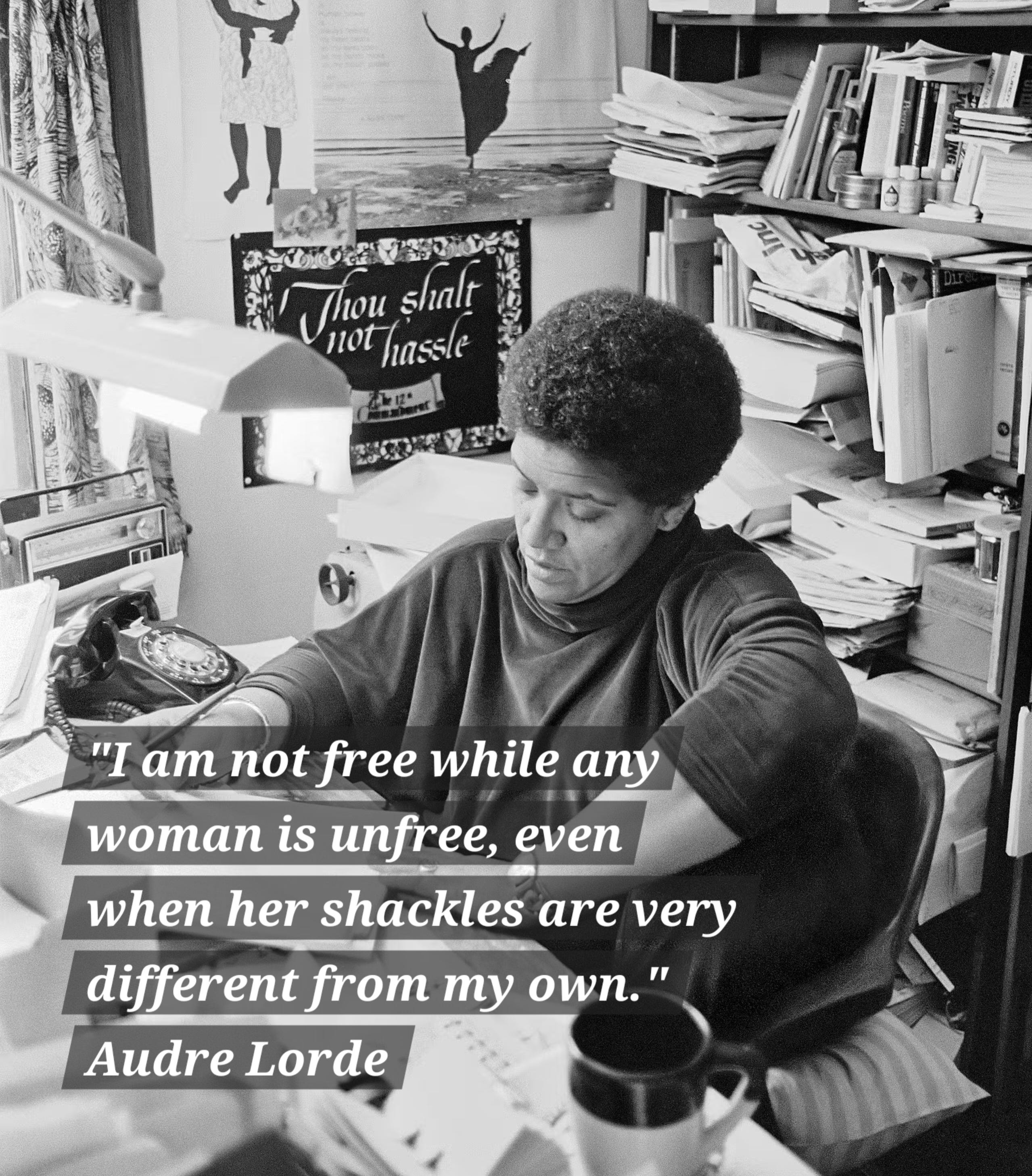
In Masculine Domination, Bourdieu explains that by internalising the dominant beliefs and dispositions — through what feminists generally call female socialisation — we unconsciously reproduce it, unwillingly contributing to the maintenance of the status quo. Marilyn Frye described this system in Opression as “a network of forces and barriers which are systematically related and which conspire to the immobilization, reduction and molding of women” — the patriarchy. We’ve all internalised it in one way or another and therefore are all tasked with the uncomfortable, painful, challenging process of unpacking it, layer by — forgive me — fucking layer. We can’t seriously look at Ballerina farm and other “tradwives” and be so reductive as to say they’re privileged white women who’ve chosen this lifestyle without exploring this further, or we'd only be failing as completely as Yesteryear does at asking the question (and here I'm absolutely taking them on their word when they say this is the life they want for themselves): why? Why do some women genuinely feel that they want to leave their careers and dreams — and perhaps healthier relationships — behind and be the docile wives of domineering husbands, leading a lifestyle that women have died fighting against so we could all have more freedom, social media or not? And then we need to look at Simone de Beauvoir and Bordieu and Audre Lorde, learn from Gerda Lerner on the creation of patriarchy and from Engels on The Origin of the Family, Private Property and the State, and then we need to keep going beyond the exhaustion, beyond the dismay, beyond the utter discomfort and pain and yes, the anger, and read Silvia Federici and Marilyn Frye and Kate Millet and so much more — and never, ever stop — in order to understand our own history.
Otherwise, like Natalie, we inevitably perpetuate this cycle of what Bordieu called symbolic violence, which is sadly what Yesteryear itself does. Beyond that, it evades any deep, genuine political engagement despite its hugely political themes, losing itself in too many easter eggs and not enough investigation.
I'm sure the film will be a blockbuster.
That even one of you had subscribed to what was a completely empty space until now was hugely encouraging. If that’s you: thank you, truly.
Everything I've read that was originally written in one of the Romance languages, I have in Portuguese — yet I insist on translating the titles to English automatically as I write. To complicate things, different editions seem to have slightly different titles depending on the translator, especially when it comes to articles (with or without a, the, etc) and uppercase. The lesson: for me, double check before publishing. For you, doubt the titles if they're originally in French and Italian (case in point). If you're reading this now and made a note of any book titles on a previous read, it's all fixed now.
I think.
I can't bring myself to use the term without quotation marks or italics, which gets in the way a bit (*ahem* a lot) after the umpteenth time. I wasn't able to find a solution I was happy with, though.
What an incredible first post!!
Thank you. This book quite literally left me feeling how the patriarchy does: was this my fault, am I misunderstanding? Also, in my experience, millennials (of which Caro Claire Burke is one) are sometimes overly reductive while simultaneously critical of every detail. It’s something that has worsened in my lifetime (I’m 50). I am ALL for complaining and judging, but I’m also for nuance and trying to humanize. I sometimes wonder if this is the privilege of having grown up before everything became an online discussion and spectacle. “We can’t seriously look at Ballerina farm and other “tradwives” and be so reductive as to say they’re privileged white women who’ve chosen this lifestyle without exploring this further, or we'd only be failing as completely as Yesteryear does at asking the question (and here I'm absolutely taking them on their word when they say this is the life they want for themselves): why? Why do some women genuinely feel that they want to leave their careers and dreams — and perhaps healthier relationships — behind and be the docile wives of domineering husbands, leading a lifestyle that women have died fighting against so we could all have more freedom, social media or not?” The unwillingness or in the least the decision not to commit time in the book to examining any aspect of what made Natalie herself (instead she’s just crazy, in the end…big big yikes) feels millennial to me. Maybe that is unfair. I’d love to be challenged on it